Small Battery: Big Mistake.

The Battery you're Quoting is Too Small, and it's Costing you the Bigger Invoice.
The UK battery market is about to split in two. On one side, installers are still sizing batteries purely around simple payback calculations and self-consumption percentages, using sub-par off the shelf software, which actually creates installer risk today. On the other, top installers are beginning to understand that batteries are no longer just “bill reduction devices” they are becoming operational energy assets connected to a much larger and more dynamic electricity system.
The distinction matters.
The industry has spent years optimising around one simple idea: “smallest battery, fastest payback.” For a long time that logic made sense, but the UK energy system has changed dramatically. Time-of-use spreads are widening, DUoS and non-commodity costs are becoming increasingly important, export dynamics are shifting, and flexibility markets with VPP are opening up entirely new revenue opportunities for battery owners. At the same time, commercial customers are beginning to think operationally rather than simply electrically, viewing batteries not just as devices that reduce import costs, but as infrastructure assets capable of supporting resilience, peak-load management, operational continuity and future participation in increasingly dynamic energy markets.
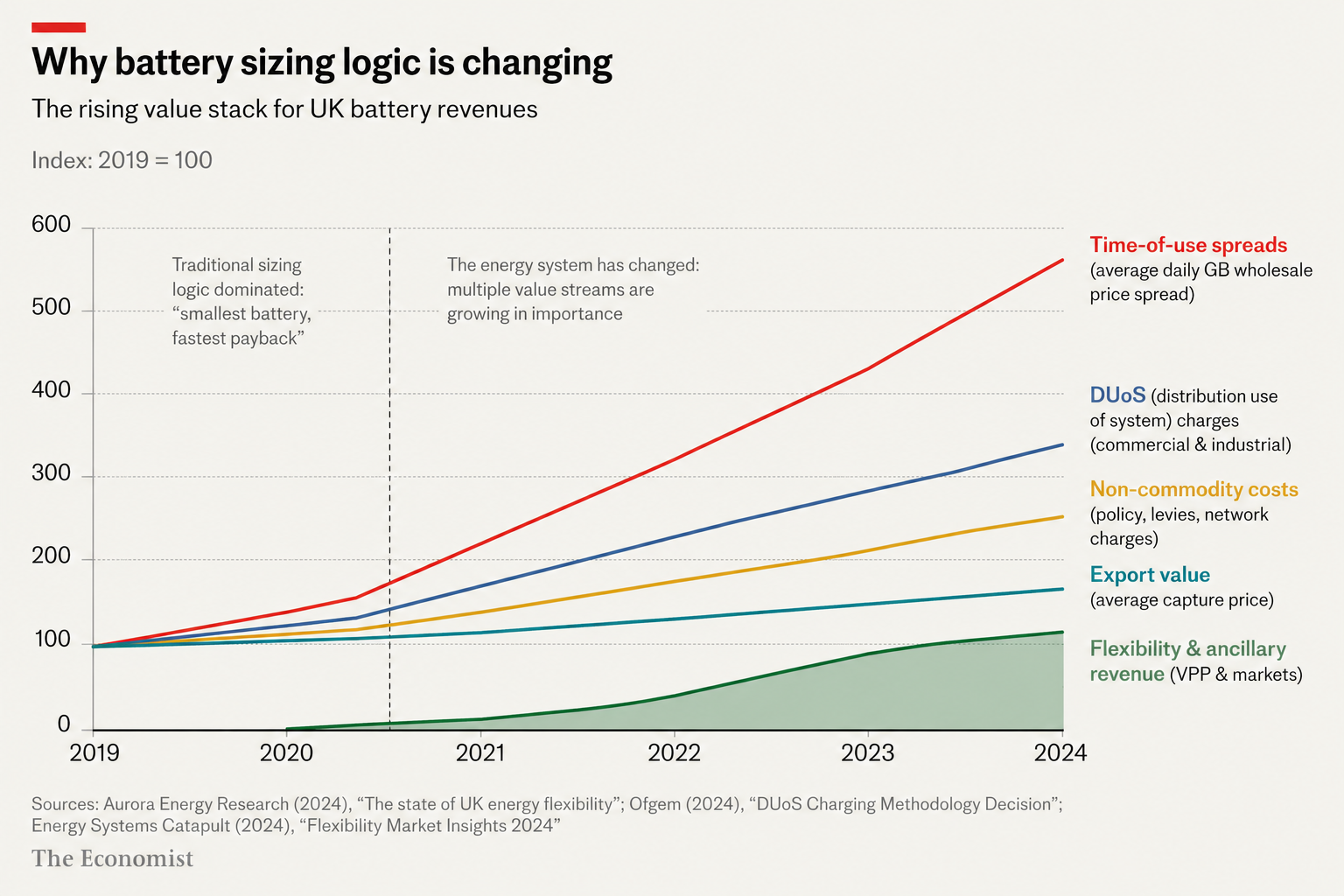
Many installers are still quoting systems as though none of that happened.
The result? Thousands of systems are now being installed that are technically “correct” for yesterday’s market - but undersized for tomorrow. The customer outgrows the system quickly. The installer loses future revenue opportunity and the site becomes harder and more expensive to optimise later.
In this deep-dive article we examine why traditional battery sizing logic is beginning to break down, why resilience is becoming commercially valuable again, how flexibility markets are changing the economics of battery storage, and why DUoS and non-commodity cost avoidance are becoming increasingly important in both commercial and high-consumption residential settings. We explore why future-proofing a site may now matter more than simply minimising upfront capex, how installers can reposition themselves from “battery fitters” into long-term energy advisers, and why the next phase of the UK storage market is likely to favour firms that understand energy systems, operational flexibility and electricity market dynamics - not just hardware specifications and payback calculators.
This is not an argument for irresponsibly oversizing batteries.
It is an argument for recognising that the electricity system itself is changing — and that battery sizing should increasingly reflect operational flexibility, future electrification, energy market participation and long-term site evolution.
The installers who understand our strategy set out here and shift early will write larger projects, create stickier customer relationships, and become strategically far more valuable over the next five years. The ones still quoting purely off the bill may find themselves trapped in a shrinking, margin-compressed commodity market.
Now Read the full report and reap your rewards on profit maximising!