Flexibility, and why it matters for profit.
Flexibility has changed battery economics forever. An installer's guide to the UK’s fastest-changing energy market.
For most people, the electricity system has traditionally been quite simple. Large power stations generated electricity, which was then transported across the grid to homes and businesses. Consumers used electricity when they needed it, and suppliers issued bills afterwards.
That model is now changing rapidly. Across the UK, technologies such as solar PV, battery storage, electric vehicles, heat pumps and smart meters are changing the role of buildings within the energy system. Homes and commercial sites are no longer only consumers of electricity. Increasingly, they can also generate, store and manage energy in ways that support the wider grid. They offer "flexibility".
Flexibility matters to installers because it is increasingly the difference between a battery that simply saves money and a battery that can generate additional value, making larger and smarter systems more attractive to customers.
At the same time, the electricity network itself is under growing pressure. Demand for electricity is expected to rise significantly over the next decade as transport and heating become more electrified. Renewable generation itself is also increasing quickly, particularly from wind and solar, which means supply can vary considerably depending on weather conditions. As we know - the sun and the wind tend not to shine and blow precisely and repeatedly when the demand is at its peak.
This creates a new challenge for the grid: balancing supply and demand in real time while keeping costs under control and maintaining network stability.
This is where flexibility becomes important.In simple terms, flexibility means adjusting when and how electricity is generated, stored or consumed in response to conditions on the grid. That adjustment may involve charging a battery when electricity is cheap and plentiful, reducing demand during peak periods, or exporting stored energy back to the grid when it is needed most.
For installers, flexibility is becoming an increasingly important part of the market. Customers are no longer only asking for hardware such as solar panels or batteries. They also want to understand how these systems can reduce bills, generate revenue and interact with tariffs, aggregators and grid services.
Understanding flexibility therefore helps installers explain the value of modern energy systems more clearly and position themselves within a market that is becoming more software-driven and service-led.
This guide explains the main concepts behind flexibility in straightforward terms, including how the market works, why it matters to the UK energy system, and how technologies installed today are likely to participate in the energy market in future.
Structure of This Guide:
1: What Is Flexibility?
A simple explanation of what flexibility actually means in practical terms, including why the grid increasingly needs energy demand and supply to become more dynamic.
2: Why the UK Grid Suddenly Needs It
How renewables, EVs, heat pumps and electrification are changing the shape of the electricity system — and why traditional grid infrastructure is struggling to keep up.
3: The Problem with Renewable Energy
Why wind and solar create intermittency challenges, how supply and demand must be balanced second-by-second, and why batteries are becoming increasingly valuable.
4: The Rise of the Battery
How battery storage evolved from backup power into an operational grid asset capable of load shifting, arbitrage, resilience and flexibility participation.
5: Time-of-Use Tariffs Explained
A beginner’s guide to off-peak electricity, dynamic pricing, Agile-style tariffs and why electricity increasingly behaves like a live commodity market.
6:What Is a Virtual Power Plant (VPP)?
How thousands of distributed batteries can be connected together and controlled as one coordinated energy resource.
7: Understanding Aggregators, VTPs and Energy Traders
A plain-English explanation of the companies sitting between batteries and electricity markets, including:
- aggregators
- Virtual Trading Parties (VTPs)
- optimisation platforms
- and settlement systems
8:How Flexibility Actually Makes Money
A walkthrough of the major flexibility revenue streams including:
- arbitrage
- demand shifting
- frequency response
- Capacity Market participation
- and DNO flexibility services
9: Why Flexibility Matters to Installers
How flexibility changes battery sizing conversations, why future-proofing matters, and why installers increasingly need to understand energy systems — not just hardware.
10: The Next Five Years
Where the market may be heading next, including:
- smarter tariffs
- automated home energy systems
- vehicle-to-grid
- AI-driven optimisation
- and why flexibility may become one of the defining energy markets of the 2030s.
Plus: key terms explained, glossary, templates, how to explain to customers. So read on!
1: What Is Flexibility?
Flexibility is one of those terms that appears everywhere in the modern energy industry, yet many people struggle to define it clearly.
In its simplest form, flexibility means using electricity at a different time from when it would normally be used. That might sound almost too simple, but it sits at the heart of one of the biggest changes taking place in the UK energy system.
For most of the last century, electricity generation followed demand. When people switched on kettles, factories started production lines or offices opened their doors in the morning, power stations increased output to meet that demand. The grid was built around the principle that generation would follow consumption.
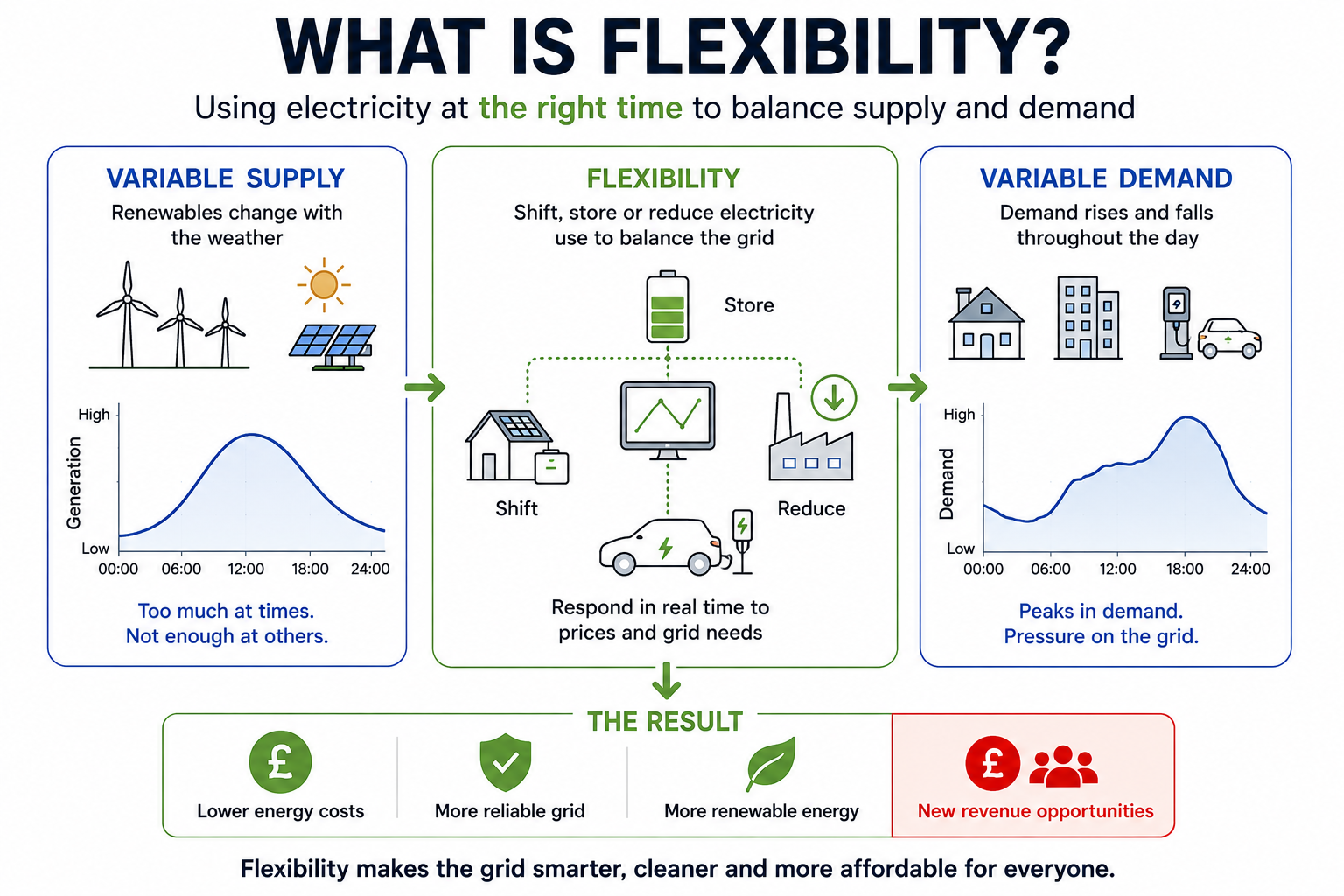
Today, that relationship is beginning to reverse. Increasingly, electricity generation comes from renewable sources such as solar and wind. These technologies generate electricity when the weather allows rather than when consumers necessarily need it. Solar panels generate most of their power around midday. Wind farms generate when the wind blows. Neither technology particularly cares what time people want to charge their cars, cook dinner or run a manufacturing process.
This creates a challenge. Sometimes there is more electricity available than the grid needs. At other times there is not enough. The traditional solution was to build more power stations. The modern solution is often to make demand more flexible.
A simple example helps illustrate the point. Imagine a battery that charges overnight when electricity is abundant and inexpensive. The following evening, when electricity demand is high and prices are elevated, that same battery discharges energy back into the building instead of importing electricity from the grid. Nothing magical has happened!
The customer has simply moved electricity consumption from one time period to another. That is flexibility.
The same principle applies to electric vehicles, heat pumps, refrigeration systems, industrial processes and increasingly entire buildings. Rather than consuming electricity whenever equipment happens to be switched on, flexibility allows energy consumption to be shifted, reduced, stored or exported in response to changing conditions.
Why does this matter? Because timing is increasingly becoming as important as consumption. Two businesses may use exactly the same amount of electricity over a day. However, the business that can move some of its demand away from expensive peak periods may spend considerably less money and place less strain on the grid.
The same logic applies nationally. If millions of homes, batteries, electric vehicles and commercial sites can respond intelligently to electricity prices and grid conditions, the network becomes more efficient, more resilient and easier to operate.
Flexibility has become one of the most important concepts in modern energy policy. It helps integrate renewable energy. It reduces pressure on network infrastructure. It lowers system costs. And increasingly, it creates commercial opportunities for those who can provide it.
For installers, this matters because batteries are no longer being sold purely as self-consumption devices. Increasingly, customers want to understand how their systems can respond to tariffs, participate in future energy services and potentially generate value beyond simple bill savings. Understanding flexibility is therefore no longer optional industry knowledge. It is rapidly becoming a core part of the battery conversation itself.
2: Why Flexibility Matters to Installers
For most of the history of the UK solar and storage industry, the conversation has been dominated by hardware.
Bigger panels.
Better inverters.
Larger batteries.
Lower installation costs.
Success was measured largely by how much equipment could be installed and how quickly the investment paid for itself.
That world is changing.
The next phase of the industry is not primarily about hardware. It is about what that hardware can do once it has been installed. A battery sitting quietly in a garage is a useful asset.
A battery that can intelligently charge, discharge, avoid expensive network charges, respond to electricity prices, participate in flexibility markets and support the wider grid becomes something entirely different. It becomes an active energy asset.
That distinction matters because the value of energy storage is increasingly moving away from the physical battery itself and towards the services that battery can provide. As battery costs continue to fall, the software, optimisation and market access layers become increasingly important sources of value. This is one of the core themes behind emerging Virtual Power Plant (VPP) models and flexibility services.
For installers, this shift creates both a challenge and an opportunity. The challenge is that customers are becoming more sophisticated. They are no longer simply asking:"How big is the battery?" Increasingly they are asking: "What else can the battery do?" and this question fundamentally changes the sales conversation.
Instead of discussing only self-consumption and payback periods, installers can begin discussing energy trading, time-of-use optimisation, grid services, resilience and future revenue opportunities.
The installer who understands flexibility can have a very different conversation from the installer who only understands hardware.
Consider two identical battery systems. The first charges from solar and discharges in the evening. The second does exactly the same thing, but also responds to electricity prices, participates in flexibility services and earns additional revenue whenever spare capacity is available.
The physical hardware may be identical. The economics are not. This is why flexibility is rapidly becoming one of the industry's most important differentiators. A useful way to think about it is that batteries are evolving from energy-saving devices into financial assets.
When a customer buys a battery today, they are not simply buying backup power or lower electricity bills. They are potentially buying access to a future marketplace where electricity can be bought, stored, sold and optimised automatically. The larger the battery, the more flexibility becomes available.
This is one reason why battery upgrade programmes are becoming increasingly attractive. Once basic household needs have been met, additional storage capacity can be used for activities such as overnight charging, time-shifting and participation in flexibility markets. Larger batteries create more spare capacity, and spare capacity is ultimately what flexibility services monetise.
For installers, this creates a significant commercial opportunity. Historically, revenue was generated primarily from the installation itself. In the future, installers may increasingly participate in ongoing customer relationships, upgrades, monitoring services, optimisation programmes and flexibility platforms. The relationship becomes longer-term rather than ending when the installation is commissioned.
This changes customer retention as well. A customer who receives ongoing value from a battery system is less likely to view it as a one-off purchase. Instead, it becomes part of a wider energy ecosystem that continues to evolve over time. The UK energy system is moving in this direction because it has little choice.
Renewable generation is growing rapidly. Electric vehicles are increasing demand. Heat pumps are changing consumption patterns. National Grid and distribution networks require increasing levels of flexibility to balance these competing pressures. Distributed batteries are emerging as one of the fastest and most scalable ways of providing that flexibility. The industry increasingly views aggregated batteries as an important source of flexible capacity for the future electricity system.
For installers, the message is simple. The battery itself is no longer the whole product. The battery is the platform. Flexibility is what sits on top. And over the coming decade, that flexibility layer may prove to be more valuable than the hardware that made it possible in the first place.
3: Why the UK Grid Suddenly Needs Flexibility
Most installer articles jump straight into batteries, VPPs and revenue streams. The problem is that many people still don't understand why flexibility exists in the first place. Installers - you're a practical bunch, our guess is if you understand the problem, everything else makes sense.
For most of the last century, the electricity system was remarkably predictable. Large power stations generated electricity when people needed it, using coal as the main source of power to drive generators. Demand would rise in the morning as businesses opened, increase again in the evening as people returned home, and fall overnight as the country slept. Grid operators simply increased or reduced generation to match demand.
The challenge facing today's electricity system is that generation is no longer following demand.
Increasingly, demand is having to adapt to generation.That may sound like a subtle distinction, but it represents one of the largest structural changes in the history of the UK energy system.
Over the next decade the UK intends to connect enormous amounts of renewable generation to the grid. Wind farms and solar farms are now being built faster than almost any other form of generation because they are cleaner, cheaper and politically supported.
The problem is that neither technology generates electricity when consumers necessarily need it. Solar panels produce most of their energy around the middle of the day. Wind farms produce electricity whenever the wind happens to be blowing. Sometimes that coincides perfectly with demand. Sometimes it doesn't.
On a bright spring afternoon, the country may have more renewable electricity available than it can comfortably use. Six hours later, just as people arrive home, start cooking dinner, charge electric vehicles and switch on heating systems, solar generation disappears almost entirely.
Demand rises sharply. Generation falls sharply. The gap between those two events must be filled somehow; without it renewable energy is practically very limited. Historically, the "gap" role was performed by fossil fuel power stations, more recently "gas peakers" or smaller gas powered power stations. Increasingly however, the UK wants batteries, flexible demand and energy storage to perform that role instead. This challenge becomes even more significant as electric vehicles and heat pumps become commonplace.
A petrol station does not place additional demand on the electricity network. An electric vehicle does. A gas boiler does not place additional demand on the electricity network. A heat pump does.
The transition to electrification is therefore creating a second challenge alongside renewable generation. Not only is supply becoming more variable, but demand is expected to increase substantially as transport and heating move away from fossil fuels. The result is a grid that needs to become far more intelligent than the one it replaces.
Rather than simply generating more electricity, the future system will increasingly need to move electricity consumption to times when renewable generation is abundant. That is flexibility.
A battery charging at 2am instead of 6pm is flexibility. An electric vehicle delaying charging until prices fall is flexibility. A commercial building reducing imports during a period of grid stress is flexibility. A supermarket refrigeration system adjusting load by a small amount to support network stability is flexibility.
None of these actions create more electricity. They simply use electricity more intelligently.And that is precisely why flexibility has become so valuable. The UK is not running out of generation. Increasingly, it is trying to solve a timing problem.
Electricity is often plentifully available. Just not necessarily at the right moment. Flexibility is what bridges that gap.
As renewable generation continues to expand, the value of that bridge is likely to increase significantly.
4: Renewable Energy Is Changing The Value Of Electricity.
One of the biggest misconceptions in the energy industry is that renewable energy automatically makes electricity simpler. In reality, renewable energy is making electricity markets significantly more complex. The reason is straightforward. For most of the last century, electricity generation could largely be controlled. If demand increased, power stations generated more electricity. If demand fell, generation reduced. The entire system was designed around matching supply to demand.
Renewable generation works differently. A solar farm generates electricity when the sun shines. A wind farm generates electricity when the wind blows. Neither technology particularly 'cares' whether consumers need electricity at that precise moment. As renewable penetration increases, the electricity system is therefore moving from one where generation follows demand to one where demand increasingly needs to adapt to generation. That distinction is becoming enormously important.
The UK is investing heavily in renewable generation because it is cleaner, cheaper and strategically important. However, the growth of wind and solar is creating a new challenge. At certain times of the day there can be enormous quantities of electricity available, while at other times supply can tighten very quickly. The challenge is no longer simply producing enough electricity. Increasingly, it is ensuring that electricity is available at the right moment. This is fundamentally a timing problem.
Consider a sunny spring afternoon. Millions of rooftop solar systems are producing electricity. Utility-scale solar farms are operating at full output. Wind farms may also be generating strongly. At the same time, commercial demand is relatively subdued, factories are operating below peak consumption and many households are empty. The country suddenly finds itself with more electricity than it immediately needs.
Historically this would have been regarded as a good problem to have. Today it increasingly creates operational and economic challenges. Electricity cannot simply be stored in a warehouse until it is required. Supply and demand must remain balanced continuously. If too much electricity enters the system, prices begin to fall. If supply significantly exceeds demand, prices can collapse altogether. This is where one of the most fascinating developments in modern energy markets begins to emerge.
Electricity occasionally becomes so abundant that it effectively loses value. In some circumstances, wholesale electricity prices can even become negative. This means generators are effectively paying the market to absorb electricity because reducing output may be more expensive or operationally difficult than continuing to generate.
What would have sounded absurd twenty years ago is becoming an increasingly regular feature of electricity markets with high levels of renewable penetration. For most consumers, this phenomenon remains largely invisible.
For battery owners, however, it represents a significant opportunity. A battery has the unique ability to separate when electricity is purchased from when it is consumed. It can absorb electricity during periods of surplus generation and release that energy later when demand returns. The electricity itself does not change. What changes is its value. This is perhaps the most important concept to understand when discussing flexibility and battery economics.
The value of electricity is increasingly determined by timing. The same kilowatt-hour may have very little value at midday on a sunny Sunday and significantly greater value a few hours later when solar generation disappears, electric vehicles begin charging and households start preparing evening meals. The electricity is identical. The market value is not.
As renewable generation expands, these pricing differences are expected to become more pronounced rather than less. Periods of abundant generation will become more common. Periods of system stress will continue to occur. The spread between those two conditions is where flexibility increasingly creates value.
This is one reason why batteries are becoming much more than simple self-consumption devices. Historically, most battery systems were sold on a relatively straightforward proposition. Store surplus solar energy during the day and use it later in the evening. While that remains an important benefit, it is increasingly only part of the story. Modern battery systems are beginning to interact with electricity markets that behave very differently from those of the past.
The opportunity is no longer simply avoiding imported electricity. The opportunity is increasingly about understanding when electricity is cheap, when it is expensive, when it is abundant and when it is scarce. For installers, this represents an important shift in thinking. The conversation moves beyond hardware specifications and simple payback calculations towards a deeper understanding of how electricity itself is changing. Batteries are becoming valuable not only because they store energy, but because they allow customers to respond to changing market conditions.
In many ways, the growth of renewable energy is creating a new commodity market where timing is becoming as important as consumption. The businesses and households that can adapt to those timing signals are likely to benefit most. Batteries happen to be one of the most effective tools available for doing exactly that.
This is why flexibility matters. This is why battery economics are evolving. And this is why understanding the changing value of electricity may become one of the most important skills in the energy industry over the coming decade.
5: The Rise of the Battery
It is easy to forget that battery storage is a relatively new arrival in the mainstream energy industry. In 2015, most batteries were viewed as niche technologies. They were expensive, relatively small and generally reserved for enthusiasts, off-grid properties or specialist backup power applications. Very few people discussed batteries as serious energy infrastructure, and almost nobody talked about them as tools capable of supporting the national electricity system.
Today, the conversation could not be more different. Battery storage has become one of the fastest-growing sectors in global energy markets. Governments, utilities, businesses and homeowners are all investing heavily in storage because they increasingly recognise a simple truth: renewable energy becomes dramatically more useful when it can be stored and deployed at the right time.
This shift has transformed the role of the battery. Historically, a battery's primary purpose was resilience. If the power failed, the battery could keep essential equipment running. In commercial environments, batteries protected critical systems from outages and voltage disturbances. In residential settings, they provided peace of mind during interruptions to supply.
While resilience remains important, it is no longer the primary reason many batteries are installed. Increasingly, batteries are being deployed because they create flexibility. A battery allows electricity to be 'time-shifted'. Energy generated at midday can be used in the evening. Electricity purchased overnight can be used during expensive peak periods. Surplus renewable generation can be stored rather than wasted. Demand can be shifted away from periods of network stress.
This ability to separate the timing of generation and consumption is becoming one of the most valuable capabilities in the modern electricity system. As renewable generation continues to grow, batteries are effectively becoming the shock absorbers of the grid.
When too much electricity is available, batteries can absorb it. When electricity becomes scarce, batteries can release it. When prices fall, batteries can charge. When prices rise, batteries can discharge.
The same physical asset can perform multiple functions simultaneously, creating value in ways that would have been difficult to imagine only a few years ago. This evolution is why battery economics are changing so rapidly. The first generation of battery sales was built around self-consumption. The pitch was straightforward. Store excess solar energy during the day and use it later in the evening. Reduce imports from the grid. Improve energy independence. Shorten payback periods.
Those benefits still exist. However, modern batteries are increasingly doing far more than simply storing solar energy. They are becoming operational energy assets.
A commercial battery may charge overnight on a low-cost tariff, discharge during expensive evening periods, avoid peak demand charges, provide backup power during outages and participate in flexibility programmes throughout the year. A residential battery may optimise against dynamic tariffs, support electric vehicle charging and eventually participate in a Virtual Power Plant. (watch out for more on VPPs in future issues).
The battery itself has not changed dramatically in terms of what it does, (OK, the chemistry is stable, and prices have tumbled). What has changed is the number of opportunities available to it.
This is an important distinction, because it helps explain why battery sizing conversations are evolving.
Historically, installers often focused on finding the smallest battery capable of achieving an acceptable payback. Any unused capacity was viewed as wasted capital. The objective was to maximise utilisation and minimise upfront expenditure. Increasingly, however, spare battery capacity is beginning to acquire value in its own right.
A battery that is fully occupied servicing household demand has limited ability to respond to future opportunities. A larger battery with available headroom can participate in a wider range of optimisation strategies. It can support future electrification, accommodate electric vehicles, assist with heat pumps and potentially access flexibility services that smaller systems cannot.
This is one of the reasons larger batteries are becoming increasingly attractive despite their higher initial cost. The conversation is gradually moving away from storage and towards capability. Customers are not simply buying kilowatt-hours, they are buying options.
The option to respond to changing tariffs. The option to manage future electricity demand. The option to participate in emerging flexibility markets. The option to improve resilience. The option to adapt as the energy system continues to evolve.
In many ways, batteries are beginning to occupy a role similar to broadband infrastructure two decades ago. Initially, broadband was sold primarily as a faster way to access the internet. Over time it became clear that broadband was actually a platform upon which countless other services would be built. Streaming, cloud computing, remote working, online gaming and digital commerce all emerged because the underlying infrastructure existed.
Battery storage is following a similar trajectory. The battery itself is becoming the platform. Flexibility, optimisation, resilience and energy services are the applications that sit on top of it. For installers, this shift matters enormously.
It means the industry is gradually moving beyond hardware sales and into energy services. Understanding battery chemistry, inverter specifications and installation standards will remain important. But increasingly, understanding what a battery can do after installation may become just as valuable.
The rise of the battery is therefore not really about batteries at all. It is about what becomes possible once storage exists within the system. And as the electricity market becomes more dynamic, more electrified and more dependent on renewable generation, that possibility is only likely to grow.
6: Time-of-Use Tariffs Explained
For decades, most electricity customers paid for energy in exactly the same way. Whether electricity was consumed at two o'clock in the afternoon, six o'clock in the evening or three o'clock in the morning, the price remained largely unchanged. Consumers became accustomed to the idea that electricity was a fixed-cost commodity. A unit of electricity was a unit of electricity.
That assumption is beginning to disappear. One of the most significant changes taking place in the UK energy market is the move towards time-based pricing. Instead of paying a single rate throughout the day, customers are increasingly being offered tariffs where the cost of electricity varies depending on when it is consumed.
At first glance this can appear complicated. In reality, it reflects something quite logical. Electricity is not equally expensive to produce at all times. When demand is low and renewable generation is abundant, electricity can be extremely cheap. When demand is high and the system is under pressure, electricity becomes more expensive. Historically, much of this volatility was hidden from consumers by suppliers. Today, technology, smart meters and regulatory changes are increasingly exposing those price signals directly to homes and businesses.
This is where time-of-use tariffs begin. The simplest example is a day-and-night tariff. Electricity consumed overnight may cost a fraction of the daytime rate because demand is lower and generation is often more abundant. Many battery systems already exploit this principle by charging overnight and discharging during more expensive periods.
However, the market is moving beyond simple day-and-night pricing. Modern tariffs increasingly allow prices to change throughout the day, reflecting actual conditions within the electricity system. Some tariffs update every half hour. Others provide pricing schedules a day in advance. The result is that electricity increasingly behaves less like a utility and more like a live commodity market.
This shift is important because it changes the way customers think about energy consumption. Historically, reducing electricity consumption was the primary route to lowering bills. Increasingly, the timing of electricity consumption matters just as much.
A business that consumes electricity at the wrong time may pay significantly more than a business consuming exactly the same amount of electricity at a different time of day. Similarly, a household with a battery can often purchase electricity when prices are low and avoid importing electricity when prices are high.
The amount of electricity consumed may remain unchanged. The cost can be dramatically different. This is one of the reasons battery storage has become so valuable.
Without storage, most consumers have relatively limited control over when electricity is used. People cook when they are hungry, businesses operate when customers are present and electric vehicles are often plugged in when drivers return home. Consumption naturally clusters around periods of peak demand.
A battery changes this equation. Instead of consuming electricity at the moment it is purchased, electricity can be purchased when it is cheap and consumed later when it is valuable. The battery effectively decouples the timing of purchase from the timing of use. This simple capability sits at the heart of modern battery economics.
Consider a straightforward example. A battery charges overnight using low-cost electricity. It then discharges during the early evening when electricity prices are significantly higher. The battery has not generated any electricity. It has simply moved electricity from one period of the day to another.
Yet that timing difference can create substantial savings. As renewable generation continues to expand, these opportunities are likely to become more pronounced. Periods of surplus generation may produce very low electricity prices. At other times, particularly when renewable output falls and demand remains high, prices may rise sharply. The gap between those two conditions creates the economic opportunity that batteries are increasingly designed to capture.
This is also why installers need to understand tariffs, not just hardware. A battery installed without considering tariff structures may deliver reasonable performance. A battery installed with a clear understanding of tariff dynamics may deliver significantly greater value. Increasingly, customers are not simply purchasing storage capacity. They are purchasing the ability to respond intelligently to changing electricity prices.
The rise of time-of-use tariffs represents more than a pricing innovation. It is a fundamental change in the relationship between consumers and the electricity system.
For the first time, millions of homes and businesses are beginning to see the true value of electricity at different moments throughout the day. Those price signals are creating incentives to behave differently, use electricity differently and invest in technologies that can respond automatically. Batteries happen to be one of the most effective tools available for doing exactly that.
And as electricity pricing becomes increasingly dynamic, understanding tariffs may become just as important as understanding generation itself. In the next section, we will examine how thousands of these batteries can be connected together and operated as a single coordinated resource through something called a Virtual Power Plant, or VPP.
7: What Is a Virtual Power Plant (VPP)?
One of the most common reactions people have when they first hear the term "Virtual Power Plant" is confusion. The name sounds technical, complicated and perhaps slightly futuristic. Many people imagine vast control rooms, giant batteries and highly sophisticated energy infrastructure.
In reality, the concept is surprisingly simple. A Virtual Power Plant, or VPP, is simply a collection of smaller energy assets that are connected together and operated as if they were one much larger power source. Those assets might include batteries, solar panels, electric vehicles, heat pumps or commercial energy systems. Individually, each asset may be relatively small. Collectively, however, they can represent a substantial amount of flexible capacity.
The key idea is aggregation. A single domestic battery may only have a modest impact on the electricity system. Even a large commercial battery may be too small to participate directly in certain markets. However, if thousands of batteries are connected together through software, they begin to behave like a much larger resource.
Ten thousand homes with 10 kWh of available battery capacity represent approximately 100 MWh of storage. One thousand businesses with 100 kWh batteries represent another 100 MWh. At that point, the aggregated fleet starts to become meaningful from the perspective of the electricity system.
This is where the Virtual Power Plant concept begins. The batteries remain exactly where they are. Nobody physically moves them. Nothing changes from the customer's perspective. The "virtual" part refers to the fact that software connects these assets together and allows them to operate in a coordinated manner.
Instead of seeing thousands of individual batteries, the electricity market can effectively see one large flexible resource. This is important because electricity markets generally prefer dealing with larger assets. Customers themselves cannot trade directly into markets either - because they are too small individually.
National Grid does not want to negotiate separately with 10,000 homeowners every time additional flexibility is required. Market operators need resources that can respond predictably, reliably and at meaningful scale. Aggregation solves that problem.
A Virtual Power Plant acts as the bridge between small distributed assets and large electricity markets. When the grid needs support, the VPP can coordinate thousands of individual batteries simultaneously. Some may charge. Others may discharge. Others may simply remain available if required. The customer rarely notices anything happening.
Behind the scenes, however, the combined response can be equivalent to a traditional power station. This is one of the reasons the energy industry has become so interested in distributed battery storage. Historically, supporting the grid required large centralised infrastructure. If additional flexibility was required, a utility-scale asset would be built specifically for that purpose.
Today, millions of pounds worth of storage capacity already exists inside homes and businesses across the country. The challenge is not creating flexibility. The challenge is coordinating it.
A Virtual Power Plant provides the software layer that makes that coordination possible. The installers own the trust layer between the customer (home or business) and the energy trade. An easy analogy is ride-sharing. A single driver with a single car cannot create a transportation network. However, thousands of drivers connected through a platform suddenly become something much larger than the sum of their individual parts. The platform coordinates availability, allocates demand and creates value from assets that already exist.
A Virtual Power Plant works in much the same way. The batteries provide the physical capability. The software provides the coordination and the combined fleet becomes a market participant.
For battery owners, this can create opportunities that would otherwise be inaccessible. Many flexibility markets require minimum participation thresholds. A single domestic battery may be too small to qualify on its own. Once aggregated with thousands of others, however, it can contribute towards a resource large enough to participate.
This is where the future becomes particularly interesting. Historically, customers bought batteries primarily to reduce imports and improve resilience. Increasingly, batteries may also become participants in wider electricity markets through Virtual Power Plants. The battery continues performing its normal functions, but when spare capacity exists, it can contribute towards the needs of the wider system.
This is one of the reasons larger batteries are often more attractive within VPP models. A battery that is fully occupied servicing household demand has limited spare capacity available for aggregation. A battery with additional headroom can potentially contribute more flexibility while still meeting the customer's own requirements.
For installers, understanding this concept is becoming increasingly important. Customers are beginning to hear terms such as Virtual Power Plants, flexibility services and grid participation. They are asking questions about future revenue opportunities and whether their battery can do more than simply store solar energy.
The installer who can explain the VPP concept clearly immediately moves beyond a hardware conversation. They begin discussing the future role of the battery within the wider electricity system. That is an entirely different conversation.
And it is one that is becoming increasingly relevant as the UK continues its transition towards a more distributed, renewable and flexible energy network. In the next section, we will look at the organisations that make all of this work: aggregators, Virtual Trading Parties, optimisation platforms and energy traders. These are the companies that sit between batteries and the electricity markets, turning flexibility into something that can actually be bought, sold and monetised.
8: Understanding Aggregators, VTPs and Energy Traders.
By this point, you may be wondering something quite reasonable. If batteries can participate in electricity markets, who actually makes that happen? After all, most homeowners are not sitting at their kitchen tables trading electricity. Most businesses do not have dedicated energy traders monitoring wholesale markets throughout the day. And installers certainly do not want to spend their evenings placing bids into balancing mechanisms.
This is where a number of specialist organisations enter the picture. The challenge is that the industry has done a terrible job naming them. Virtual Trading Parties. Aggregators. Optimisation platforms. Flexibility providers. Market access providers. Route-to-market partners.
To somebody outside the sector, it can sound like an alphabet soup of acronyms and jargon. Fortunately, the underlying concept is much simpler than the terminology suggests. All of these organisations exist for one reason. To connect batteries and other flexible assets to electricity markets.
Think of them as translators. On one side sits the battery owner. This might be a homeowner, a pub, a supermarket, a factory or a commercial property portfolio. On the other side sits the electricity system, which is constantly buying and selling flexibility, balancing supply and demand, managing network constraints and responding to changing market conditions.
The battery owner speaks the language of energy savings. The electricity market speaks the language of megawatts, settlement systems, dispatch instructions and trading positions. Somebody needs to sit in the middle and connect the two. That is effectively the role of the aggregator.
The aggregator
An aggregator collects together many smaller energy assets and combines them into a larger portfolio. Instead of presenting a single battery to the market, the aggregator presents hundreds or thousands of batteries operating together. This aggregation process is what makes small assets commercially viable.
A single battery installed in a village may be too small to attract attention. One thousand batteries operating together become a meaningful energy resource. The aggregator is therefore responsible for coordinating assets, monitoring performance and ensuring that customers receive instructions that align with wider system requirements.
In many ways, the aggregator is the conductor of an orchestra. The individual instruments remain separate. The music only works when somebody coordinates them.
The optimisation platform
Behind most aggregators sits an optimisation platform. This is the software layer that decides what the battery should actually do.
Should it charge now? Should it discharge? Should it remain available for a potential flexibility event later in the day? Should it prioritise arbitrage, resilience or flexibility revenues?
The optimisation platform continuously evaluates market conditions and makes decisions designed to maximise value while respecting customer requirements. This is increasingly where much of the industry's intellectual property resides. The battery hardware may be identical. The optimisation strategy often is not.
Two identical batteries connected to different optimisation platforms can generate very different outcomes over time. This is one reason software is becoming such an important part of battery economics.
The Virtual Trading Party
The next piece of the puzzle is the Virtual Trading Party, often shortened to VTP. This is usually the point where eyes begin to glaze over. In reality, the concept is relatively straightforward. Electricity markets operate within highly regulated settlement systems. Participants must be registered, accredited and capable of meeting strict operational requirements before they can trade directly.
Most battery owners do not want that responsibility and most aggregators do not either. Instead, a Virtual Trading Party acts as the formal market participant. The VTP holds the necessary registrations, interacts with settlement systems and provides access to wholesale electricity markets and flexibility opportunities. Think of the VTP as the licensed vehicle that allows flexibility to enter the market. Without it, participation becomes significantly more difficult. With it, thousands of batteries can collectively access opportunities that would otherwise remain unavailable.
The energy trader
Finally, there is the trader. The trader's role is to determine where value exists within the market and position the aggregated fleet accordingly. At a simplistic level, this may involve charging batteries when electricity is cheap and discharging them when prices rise.
In reality, modern energy trading is considerably more sophisticated. Traders constantly assess wholesale markets, flexibility opportunities, network constraints, balancing requirements and future price expectations. Their objective is to maximise the value generated by the portfolio.
This expertise is one reason VTPs and traders often earn a meaningful share of flexibility revenues.From the outside, flexibility can appear simple.
Charge low. Discharge high.
In practice, delivering reliable performance across thousands of assets, complying with market rules, managing settlement risk and optimising across multiple revenue streams requires specialist skills and systems. The reality is that most battery owners would never attempt to do this themselves.
Putting it all together
When viewed together, the structure becomes much easier to understand. The battery provides the physical flexibility. The aggregator combines thousands of batteries into a meaningful portfolio. The optimisation platform decides how those assets should behave. The VTP provides market access. The trader identifies opportunities and captures value. Each layer performs a specific role and adds value. And each layer enables batteries to participate in markets that would otherwise be inaccessible.
This is important for installers because customers increasingly hear terms such as VPP, aggregator, VTP and flexibility provider without understanding how they fit together. Being able to explain this ecosystem simply helps installers move beyond a hardware discussion and into a much more strategic conversation about the future role of battery storage.
Ultimately, flexibility is not created by a single battery, it is created by an entire ecosystem working together. The battery may sit on the customer's wall. But behind it sits an increasingly sophisticated network of software, traders, aggregators and market participants all working to unlock the value stored inside that asset.
In the next section, we will follow the money and examine exactly how flexibility generates revenue, including arbitrage, frequency response, Capacity Market participation and DNO flexibility services.
9: How Flexibility Actually Makes Money
At this point, we have explored what flexibility is, why the grid needs it, how renewable energy is changing electricity markets, the role of batteries, the emergence of Virtual Power Plants and the ecosystem of aggregators, traders and optimisation platforms that sit behind them.
The obvious question is: Where does the money actually come from? ... and this is often where confusion begins. Many people assume flexibility is a single market or a single revenue stream. In reality, flexibility is an umbrella term covering a number of different opportunities. Some are well established. Others are still emerging. Some generate modest but predictable income. Others are more volatile but potentially more lucrative.
The important thing to understand is that flexibility is not usually about a battery doing one thing. It is about a battery performing multiple functions throughout the year and earning value from each of them. This concept is often referred to as revenue stacking. The battery may earn savings from one activity, revenue from another and additional payments from a third. The combined effect is what creates the overall business case.
Energy arbitrage
The simplest flexibility revenue stream is arbitrage. The concept is straightforward; Buy electricity when it is cheap, use it or sell it when it is expensive.
If electricity costs 7p per kilowatt-hour overnight and 30p per kilowatt-hour during the evening peak, a battery can exploit that difference by charging during the cheaper period and discharging during the more expensive period. This is effectively what many domestic battery systems already do today.
No flexibility contract is required. No complex market participation is necessary. The battery is simply responding to price differences.
Historically, arbitrage opportunities were relatively modest because electricity prices were comparatively stable. Increasing renewable penetration, time-of-use tariffs and wholesale market volatility are making these spreads increasingly attractive. This is one reason battery economics are improving even without participation in wider flexibility markets.
Demand shifting
Demand shifting is closely related to arbitrage but focuses on changing when electricity is consumed rather than simply responding to tariff differences. For a commercial customer, this may involve reducing imports during expensive periods and increasing consumption when network conditions are more favourable. The financial benefits can come from lower energy costs, lower peak demand charges and reduced exposure to certain network charges.
In many commercial environments, demand shifting can be worth as much as traditional energy arbitrage. This is one reason installers are increasingly being asked to understand the customer's operational profile rather than simply their annual electricity consumption. The timing of demand is often just as important as the volume.
Frequency response
One of the electricity system's most important jobs is maintaining frequency stability. In the UK, the grid operates at 50 Hertz. If generation and demand become unbalanced, frequency begins to move away from this target. Too much deviation can create operational problems and, in extreme cases, threaten network stability.
Historically, large power stations provided most of this balancing service. Increasingly, batteries are proving exceptionally good at it. Unlike conventional generators, batteries can respond almost instantly. They can absorb power or inject power within seconds, making them highly effective tools for helping maintain frequency stability. Because of this capability, grid operators are often willing to pay for access to fast-responding assets.
The battery may only be called upon occasionally, but it receives value from being available when required. This introduces an important concept within flexibility markets. Sometimes the payment is for doing something, often it's simply for being ready to do something.
Capacity Market participation
The Capacity Market operates on a similar principle. The electricity system needs confidence that sufficient resources will be available during periods of peak demand.Rather than waiting for a crisis to emerge, National Grid procures capacity in advance. Participants receive payments in exchange for being available when required.
The easiest way to think about the Capacity Market is as an insurance policy for the grid. The system is effectively paying resources to stand by in case they are needed. For larger battery fleets and aggregated portfolios, these payments can become an important component of the overall revenue stack. The battery may spend most of the year performing other functions, but its availability still has value.
DNO flexibility services
Not all electricity problems occur at a national level. Many challenges exist within local distribution networks, managed by Distribution Network Operators (DNO) A particular area may experience congestion during peak periods. A local substation may be approaching capacity. A growing number of electric vehicles may be creating pressure on specific sections of the network.
Historically, the solution would often involve reinforcing the network, such as new cables, new transformers, or new infrastructure, but these upgrades can be expensive or not within a schedule of possibility for the DNO.
Increasingly, DNOs are exploring whether flexibility can provide a cheaper alternative. Instead of investing millions in physical infrastructure, the DNO may pay flexible assets to modify their behaviour at specific times. A battery might be paid to discharge during a local constraint event. Alternatively, it may be asked to delay charging until network conditions improve.
The objective is simple: use flexibility before concrete and copper, spread the cost of scarce resources to where they are needed most. For battery owners, this creates another potential revenue opportunity.
Revenue stacking changes everything
The most important lesson from all of these examples is that batteries rarely rely on a single source of value.
A battery may save money through arbitrage. Reduce costs through demand shifting. Provide resilience benefits to the customer. Participate in frequency response. Support Capacity Market obligations and Contribute to local DNO flexibility services.
Each individual revenue stream may appear relatively modest, but together, they can become significant. This is why modern battery economics look very different from the simple self-consumption models of the past. The value is increasingly being created by combining multiple opportunities rather than relying on a single source of savings. This is also why larger batteries often perform better than traditional payback models suggest.
Additional capacity creates additional optionality. Additional optionality creates access to more revenue streams. And access to more revenue streams creates more opportunities to stack value.
Why installers should understand this
Installers do not need to become energy traders, but they do not need to master balancing mechanisms or understand every detail of electricity market settlement. They do need to understand where the value is coming from.
Customers increasingly hear phrases such as flexibility, Virtual Power Plants and grid services. They want to know whether these opportunities are real and whether battery storage can participate. The installer who can explain the difference between arbitrage, flexibility and grid services immediately becomes more than a hardware supplier, they become an adviser.
And as the market continues to evolve, that distinction is likely to become increasingly important. In the next section, we will bring everything together and examine why flexibility is changing the role of the installer, why traditional battery sizing methods are being challenged, and why the most successful installers of the next decade may be those who understand energy systems rather than simply energy hardware.
10: Why Flexibility Matters to Installers
For much of the history of the solar and storage industry, the commercial proposition was relatively straightforward. A customer's electricity consumption was analysed, a solar system was designed around that demand profile, and where appropriate a battery was added to increase self-consumption and reduce imports from the grid. The installer's task was to recommend a technically appropriate system and demonstrate a satisfactory financial return.
That approach built a successful industry and remains relevant today. However, the environment in which batteries operate is becoming considerably more complex. Electricity prices are increasingly dynamic, renewable generation is changing wholesale market behaviour, electric vehicles and heat pumps are increasing electrical demand, and flexibility markets are creating new opportunities for energy storage assets. As a result, the battery is beginning to perform a wider range of functions than simply storing surplus solar energy for later use.
This has important implications for installers because it changes the nature of the specification process. Historically, battery sizing was often driven by a desire to minimise capital expenditure while achieving an acceptable payback period. The objective was to identify the smallest battery capable of delivering meaningful savings. In a world where the battery's primary role was self-consumption, this was entirely logical.
Increasingly, however, customers are asking different questions. They want to understand whether a battery will support future electric vehicle charging, how it may interact with dynamic tariffs, whether it can provide resilience during power interruptions, and whether future participation in flexibility services or Virtual Power Plant programmes may be possible. Once these considerations enter the conversation, battery sizing becomes less about today's electricity bill and more about the future requirements of the property or business.
This does not mean that every battery should be oversized, nor that traditional payback analysis is no longer important. It does, however, suggest that installers may need to think more broadly about the role a battery will play over its operational life. A system that appears marginally larger than necessary today may prove entirely appropriate in five years' time if the customer adopts electric vehicles, electrifies heating, expands operations or participates in flexibility programmes.
Installers increasingly find themselves acting as advisers rather than simply equipment suppliers. Most customers have little understanding of electricity markets, network charging structures, flexibility services or future energy policy. They are looking for practical guidance that helps them make sensible long-term decisions. Installers who can provide that guidance are likely to create greater value for their customers and, in turn, differentiate themselves from competitors focused solely on hardware specifications and upfront pricing.
The broader trend is that battery economics are becoming increasingly influenced by factors beyond the battery itself. Tariff structures, network charges, optimisation software, aggregation platforms and market access arrangements all influence the value a battery can deliver. Two identical battery systems may therefore produce very different outcomes depending on how they are operated and integrated into the wider energy ecosystem.
For installers, this does not require becoming an energy trader or market specialist. It does, however, require a working understanding of the forces shaping the future electricity system. The industry is gradually moving from a discussion centred on equipment towards one centred on energy management, optimisation and flexibility. Hardware remains essential, but it is increasingly only one component of the overall value proposition.
Viewed through this lens, flexibility is not simply another revenue stream or industry buzzword. It is part of a broader transition in which batteries are evolving from passive storage devices into active energy assets. As that transition continues, installers who understand both the technology and the market context in which it operates are likely to be best placed to advise customers and capture the opportunities that emerge.
The battery industry remains at a relatively early stage of its development. Flexibility markets continue to evolve, Virtual Power Plants are expanding, dynamic tariffs are becoming more common and electrification is increasing across both domestic and commercial sectors. Against this backdrop, the most successful installers are likely to be those who understand not only how to install batteries, but also how those batteries fit into the wider energy system that is now beginning to take shape.
Installer Checklist — Understanding Flexibility
Before discussing flexibility with a customer, can you clearly explain:
- why electricity prices vary throughout the day?
- why batteries are increasingly valuable operationally?
- how dynamic tariffs work?
- what a Virtual Power Plant is?
- how batteries may eventually earn revenue?
- why spare battery capacity can matter?
- how EVs and heat pumps affect future demand?
- why the UK grid increasingly needs flexible assets?
- the difference between resilience and flexibility?
- how flexibility changes battery sizing conversations?
The installers who understand these concepts early are likely to become more valuable advisers as the market evolves.
Final Thought
For many years, the UK battery market focused heavily on hardware specifications, installation costs and simple payback calculations. Increasingly, however, the value of modern energy systems is becoming operational rather than purely electrical.
The battery is no longer simply a box on the wall. It is part of a wider intelligent energy system that responds dynamically to pricing, demand, grid conditions and flexibility markets. That shift is likely to become one of the defining changes in the next phase of the UK energy transition.
An understanding flexibility is the first step toward understanding where the industry is heading next.
Member discussion